
Cécile Herrmann Class : Pre-Kindergarten, 1st & 2nd year of Kindergarten
In this class, we primarily work on five areas with the children:
1. Living together
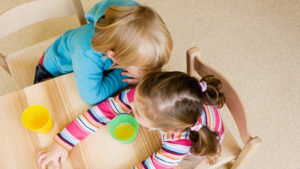
We take the time to build a strong relationship with the children (fostering a bond and classroom joy, while balancing affection with firmness) and gradually teach them to deepen their relationships with one another: showing them how to talk to each other, listen, and resolve conflicts on their own. These are valuable skills in their own right, even if the learning process is often informal, and we invest a great deal of time in them.
2. Independent workshops (Montessori-inspired)
To develop concentration and executive functions, we teach children to settle down and to perform tasks slowly and precisely. These initial skills then enable us to lay the foundations for numeracy and phonology.
3. Discovering the world
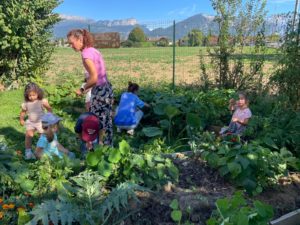
Cooking, science experiments, gardening, forest outings, raising butterflies or ladybugs, nature lessons based on what we find around us (nuts, mushrooms, bees…)…
The goal is to let them experience the reality of it all: to handle things, dive right in, learn to observe, and gain an even deeper understanding of just how fascinating it is.
4. Arts
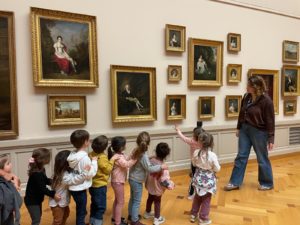
Painting, by experimenting with numerous and varied techniques; music, to learn how to listen and express oneself.
5. English
Naomi Prekel works with children in small groups (6–7) on various themes, such as animals, the human body, action verbs… Her approach involves explicit instruction while giving the children the time and space to practice speaking.
Hortense Muller Class : 3rd year of Kindergarten, 1st Grade, 2nd Grade
This class operates using a teaching approach inspired by the Montessori method. Work sessions alternate between periods of explicit instruction with the teacher (in small groups of 4–5 children) and individual practice. The goal is to enable each child to learn at their own pace through personalized work plans, while fostering autonomy and confidence. Hands-on materials allow for a concrete, progressive introduction to reading, writing, and numeracy, facilitating the consolidation of these skills.
Beyond the academic aspect, we focus on several areas:
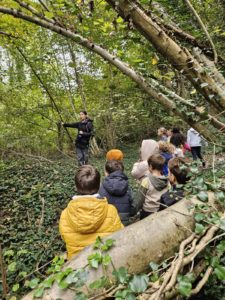
> Discover the world through observation and experimentation: by cultivating wonder around scientific experiments, outings in the forest, planting …
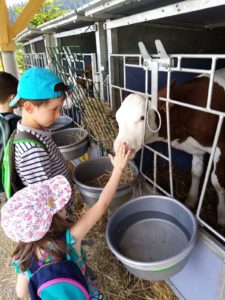
> Improve their English through artistic and manual activities (gardening, painting, basketry, origami …): Naomi Prekel carries out these sessions with small groups of children, speaking only English.
> Transform daily classroom life into a mini community life: by developing the students’ relationships with each other, and with the teacher. Listen to each other, talk to each other, accept each other, take care of each other… By anchoring themselves in everyday life: the students participate in the maintenance of the school (hanging out the laundry, tidying up and cleaning the classroom, tending the vegetable garden …).
Parents are invited to participate in classroom life, particularly during individual reading sessions or by helping out at meal times – a valuable commitment that strengthens the bond between the school and families.
Yoann Trujillo Class : 3rd Grade, 4th Grade, 5th Grade
In this multi-level class, students receive guidance that is both demanding and supportive, helping them consolidate their learning and grow in autonomy.
We are working along several lines:
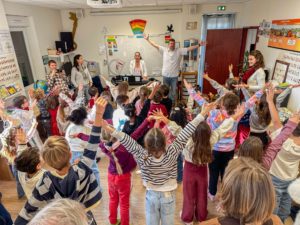
- French and mathematics: structured instruction using the “French Heuristic Method” and the Singapore method, designed to develop understanding, rigor, and a sense of purpose in learning.
- Autonomy and reflection: students are encouraged to explore, understand, and organize their work.
- Living together: mutual aid, respect, and a sense of responsibility at the heart of classroom life.
- Discovering the Bible: dedicated times for passing on Christian values and fostering personal reflection.
- Preparation for middle school: acquiring study skills and receiving gradual support to facilitate the transition.